



Have you ever wished to recite the Quran beautifully? It is the dream of every Muslim and can be achieved by learning the tajweed rules. You can learn Tajweed and its rules online and turn your dream of beautiful Quran recitation into reality.
If you are looking for a trusted Quran academy for online tajweed classes, Elite Quran is your first choice.
What Is Tajweed Quran
The word tajweed comes from the Arabic root word, which means 'to make better' or 'to improve.' In the context of Quran recitation, tajweed refers to the set of rules governing how each letter and word should be pronounced.
The science of Tajweed is about
- The proper articulation of Arabic letters
- Knowing where sounds originate in the mouth and throat (makharij).
- Understanding the rules that change pronunciation based on context.
These tajweed rules ensure that you recite the Quran exactly as it was revealed to Prophet Muhammad (peace be upon him).
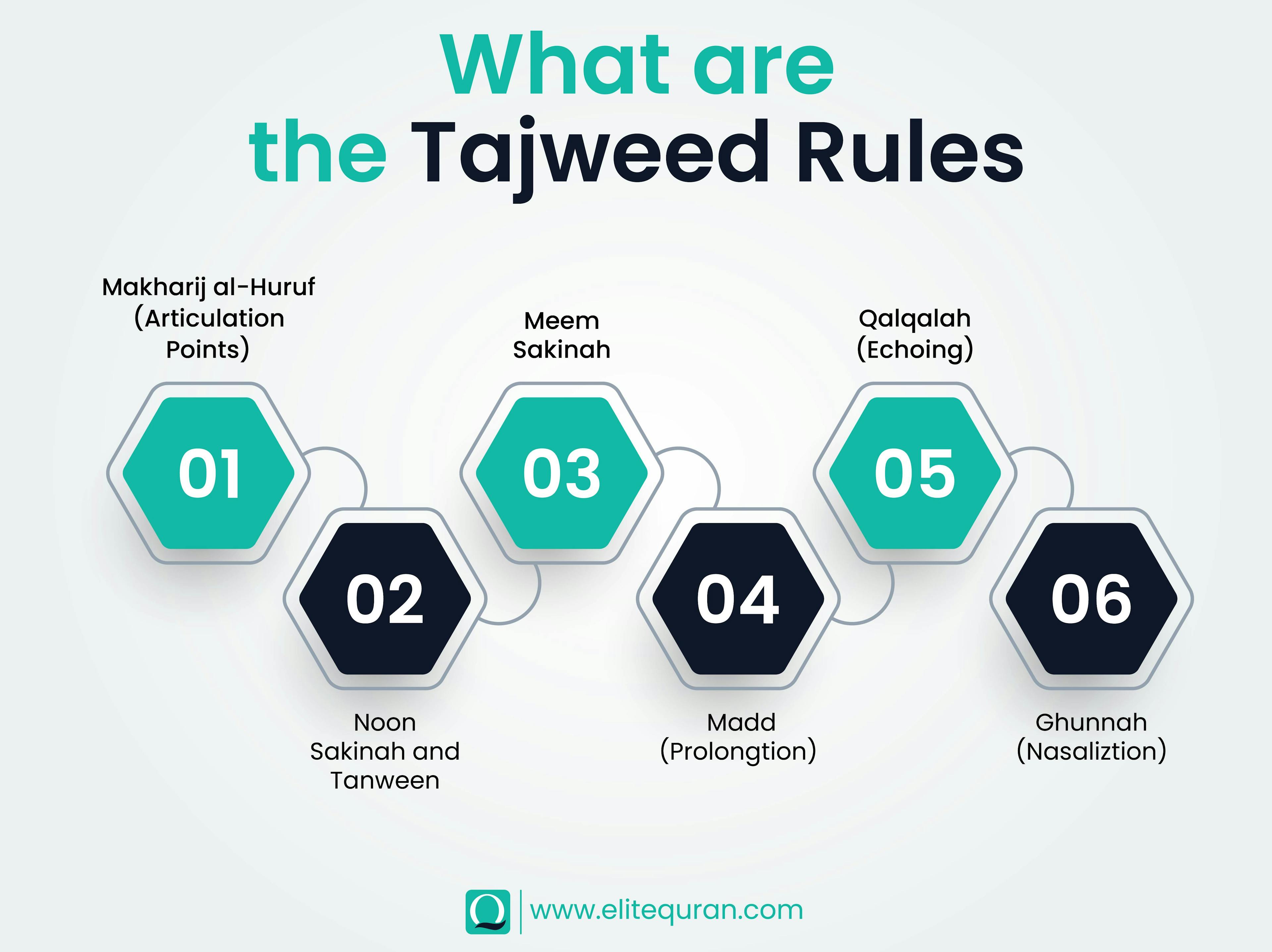
What are the Tajweed Rules
Tajweed rules احكام التجويد are the technical guidelines used to recite the Quran with the same pronunciation and rhythm as it was originally revealed. Following the rules of tajweed is important to recite the Quran perfectly.
Tajweed rules are built on a system where the pronunciation of a letter depends heavily on its origin (makhraj) and the letter that immediately follows it. Below is a detailed breakdown of the rules for learners.
Makharij al-Huruf (Articulation Points)
Makharij al Huruf refers to the exact physical locations in the vocal system where a letter's sound originates. Scholars generally identify 17 specific articulation points distributed across five major areas:
- The Throat (Al-Halq): this location is the point of articulation for 6 letters, divided into the bottom (ء, هـ), middle (ع, ح), and top (غ, خ).
- The Tongue (Al-Lisan): it is the largest area and produces 18 letters using the deep back, middle, sides, and tip.
- The Lips (Ash-Shafataan): Produce 4 letters: ب, م, و with closing/rounding, and ف with the lower lip to the upper teeth.
- The Nasal Cavity (Al-Khayshoom): It is the source of Ghunnah (nasal sound).
- The Oral Cavity (Al-Jawf): The empty space used for long vowel sounds.
Noon Sakinah and Tanween
These rules apply to a silent 'n' sound (نْ) or the 'n' sound at the end of double vowels (ً ٍ ٌ). There are four outcomes based on the following letter:
- Izhar (Clearance): Pronounce the 'n' clearly if followed by a throat letter (ء, هـ, ع, ح, غ, خ).
- Idgham (Merging): Blend the 'n' into the next letter. It is with Ghunnah (2-beat nasal sound) for letters (ي, ن, م, و) and without Ghunnah for (ل, ر).
- Iqlab (Conversion): If followed by ب, the 'n' sound changes into a light 'm' sound with a 2-beat nasal tone.
- Ikhfa (Hiding): If followed by any of the other 15 letters, hide the 'n' by keeping your tongue near the next letter's origin while producing a 2-beat nasal sound.
Meem Sakinah
These rules apply when a silent 'm' (مْ) is followed by another letter. These are often called 'Shafawi' (labial) because they involve the lips:
- Idgham Shafawi: Merge a silent مْ into another م with a 2-beat Ghunnah.
- Ikhfa Shafawi: 'Conceal' a silent مْ when followed by ب by touching the lips lightly with a 2-beat Ghunnah.
- Izhar Shafawi: Pronounce the مْ clearly for all other 26 letters.
Madd (Prolongation)
Lengthening vowel sounds (ا, و, ي) for specific durations:
- Natural Madd: 2 beats (counts). Occurs when a long vowel is not followed by a Hamza or Sukoon.
- Required/Secondary Madd: 4 or 5 beats. Usually triggered when a Hamza (ء) follows a long vowel.
- Compulsory Madd: 6 beats. Triggered when a long vowel is followed by a Shaddah (ّ) or Sukoon.
Qalqalah (Echoing)
When five specific letters (ق, ط, ب, ج, د) have a Sukoon (stop), they must be pronounced with a 'bouncing' or echoing sound.
- Minor: In the middle of a word.
- Medium: At the end of a word when stopping.
- Major: At the end of a word on a letter with a Shaddah.
Ghunnah (Nasalization)
This is a required 2-beat sound produced through the nose. It is obligatory whenever the letters ن or م have a Shaddah (ّ) on them (known as Noon/Meem Mushaddad).
Heavy and Light Letters (Tafkheem and Tarqeeq)
- Heavy (Full Mouth): Seven letters are always pronounced 'thick' with the back of the tongue raised: خ, ص, ض, غ, ط, ق, ظ.
- Light (Empty Mouth): Most other letters are pronounced 'thin.'
- Exceptions: The letter ر (Raa) and the Laam in the name of Allah can be heavy or light depending on the vowel (Fatha/Damma makes them heavy; Kasra makes them light).
Why Choose Online Tajweed Classes?
The rise of online tajweed courses has revolutionized how people learn the Quran with tajweed around the world. Here's why thousands of students are choosing digital platforms:

Flexibility That Fits Your Life
Traditional tajweed classes require you to be physically present at specific times. Online tajweed course options let you schedule lessons around your work, family, and other commitments. It is perfect for busy professionals, parents, or students. You can find a time that works for you.
Access to Qualified Instructors
When you learn tajweed online, you are not limited to teachers in your local area. You can connect with online tajweed tutors and certified instructors from around the world. It ensures you receive authentic and accurate training in the rules of reading the Quran.
One-on-One Attention
Online Quran tajweed programs offer private lessons where an instructor focuses entirely on your pronunciation, corrects your mistakes in real-time, and progresses at your pace. This personalized approach is more effective than large classroom settings.
Cost-Effective Learning
Online tajweed lessons typically cost less than in-person classes at a tajweed center. You save on transportation, and many platforms offer package deals or family discounts that make learning more affordable.
Comprehensive Resources
Most tajweed courses online provide supplementary materials like tajweed rules PDF documents, recorded lessons, and even a Quran with tajweed color coded by rule, making it easier to identify and practice different concepts.
What to Look for in an Online Tajweed Program
Several academies offer online tajweed learning courses globally. Not all platforms offering to teach Quran tajweed are created equal. Here's what separates excellent programs from mediocre ones:

Qualified and Certified Instructors
Your teacher should have a proper ijazah (certification) in Quran recitation and tajweed. They should understand not just the rules of tajweed, but also how to explain them clearly to students at different levels.
Structured Curriculum
A quality online tajweed course follows a logical progression. You should start with the basics before moving to more complex rules. Look for programs that offer a comprehensive curriculum and learning milestones.
Interactive Learning Tools
The best platforms use technology to enhance learning. This includes screen sharing, where you can see a Quran Tajweed while your teacher highlights specific rules, and recording features so you can review your recitation. Digital tools make learning Tajweed more engaging.
Flexible Scheduling Options
Always look for an institute that accommodates your schedule. The ability to reschedule when life gets busy is a significant advantage.
Free Trial Classes
Free Tajweed trial classes can help you evaluate the teaching style, platform usability, and overall fit before committing. Choose the platform that provides free trial classes.
Tools and Resources for Learning Tajweed
Learning Tajweed is supported by a wide array of digital and physical resources. There are several tools and resources that can help you.
The Color-Coded Quran
The color coded Quran is a mushaf where colors highlight different tajweed rules. For example, red might indicate a specific type of lengthening, while green shows another rule. This helps learners internalize the rules faster.
Tajweed Books and Guides
While your instructor will be your primary resource, having a good tajweed book for reference is invaluable. There are several Tajweed books in PDF that you can access on any device. These guides include explanations, examples, and practice exercises.
Audio Resources
Listening to proper Quranic pronunciation from renowned reciters is essential. Your online course should recommend specific recordings that exemplify the rules you are learning. Pay attention to how skilled reciters apply the rules of Quran recitation in their tilawah.
Practice Materials
Look for courses that provide worksheets, exercises focusing on specific rules, and even apps that help you practice. Some platforms offer a Quran with tajweed markings that you can use for independent practice between lessons.
How to Learn Tajweed Online Effectively
Online Tajweed learning is the easiest way for muslims to learn the rules and apply them in recitation. Success in mastering the Quran with tajweed rules is not just about choosing the right course, it is about how you approach the learning process. Here are proven strategies that will accelerate your progress and make your online tajweed journey more rewarding.
Choose the Right Online Quran Academy
A trusted and reputable online Quran Academy guarantees your success in online tajweed learning. Elite Quran, an online Quran Academy, is globally recognized for successful tajweed Quran teaching. We have helped thousands of students learn Tajweed from home.
Create a Dedicated Learning Space
Set up a quiet corner in your home for your tajweed lessons online. This space should be free from distractions, have good lighting, and contain everything you need, such as a device, headphones, a notebook for taking notes, and a digital Quran or a physical mushaf. Having a consistent study environment signals to your brain that it is time to focus.
Practice Consistently
A regular practice of tajweed lessons after online classes can help you get the tajweed rules easily. Even 15-20 minutes of daily practice is more effective than cramming for two hours. Focus on one rule at a time until it becomes natural. Consistency builds muscle memory in your tongue and throat, which is essential for the proper pronunciation of Quran.
Use the Listen-Repeat-Record Method
This three-step approach is gold for students learning Quran online with tajweed:
- Listen carefully to your online Quran Tutor or a professional reciter, applying a specific rule
- Repeat the verse or phrase multiple times by focusing on mimicking exactly what you heard.
- Record yourself and compare your recitation to the original.
Most smartphones have excellent recording capabilities. This self-assessment helps you identify areas that need improvement and tracks your progress over time.
Master One Rule Before Moving On
The rules of tajweed build upon each other. Do not rush to learn everything at once. For example, when you are working on Noon Sakinah rules, practice them until you can automatically identify and apply them without thinking. Then you should move to the next concept. Your instructor in the online tajweed course will guide this progression.
Review Previous Lessons Regularly
Before starting new rules, review what you have already learned. This spaced repetition ensures that earlier lessons don't fade as you progress. Many students find it helpful to maintain a 'rule review day' once a week, where they practice all previously learned concepts.
Ask Questions Without Hesitation
One of the biggest advantages of online tajweed classes is the ability to pause and ask questions. If you don't understand why a letter is pronounced a certain way, or you are confused about when to apply a specific rule, ask immediately.
Listen to Expert Recitation Daily
Beyond your lessons, spend time listening to renowned qaris (reciters). Pay attention to how they apply the rules you are learning. This passive learning, combined with active practice, can improve your ear for proper Quranic pronunciation and help internalize the rhythm and flow of correct recitation.
What is the Best Platform to Learn Tajweed Online
Elite Quran is the best platform to learn Tajweed Quran online. It is an academy that carries a sense of excellence and high standards.
Here are the reasons why Elite Quran excels in Tajweed learning
- Expert Certified Tutors: We provide access to highly qualified instructors who specialize in the rules of Tajweed and Quran recitation. Our tutors are native Arabic speakers and Hafiz-e-Quran with authentic training from reputable institutions.
- Structured and Personalized Curriculum: You will get a systematic progression from foundational Noorani Qaida for beginners to advanced Tajweed modules.
- Modern Interactive Tools: We use digital whiteboards, screen-sharing, and audio-visual aids to demonstrate proper mouth and tongue positions for difficult Arabic letters.
- Flexible & Global Access: Students can schedule classes at any time that fits their busy routine, making high-quality Islamic education accessible from the comfort of home.
- Safe and Comfortable Environment: Our platform offers a secure learning space for all ages, including specialized programs with female teachers for sisters and interactive, engaging lessons designed specifically to nurture a love for the Quran in children.
Conclusion
Learning Tajweed online provides a structured and accessible way to master Quranic pronunciation through expert-led courses, interactive digital tools, and personalized feedback. Elite Quran makes Tajweed learning easy with qualified and certified instructors from around the world.
Learn Tajweed Quran Online With Expert Tutor
Are you looking to learn Quran with tajweed online? Join our Tajweed course. Our expert tutors can guide you through the intricate rules of Tajweed to ensure you recite the Holy Book exactly as it was revealed.
Enroll Now
Frequently Asked Questions
Here are some common questions and answers about our Quran learning programs. If you have any other questions, feel free to contact us.